
Why Enterprise AI Gets Stuck in Pilots: Systems, Workflows, and Organizational Absorption

As AI and agents take on execution, our own agency expands. The question is whether organizations are built to capture it.
Microsoft, 2026 Work Trend Index Annual Report: “Agents, human agency, and the opportunity for every organization”
The questions in this article can also be addressedAI Application of entrepreneurship: from selling tools to selling results、Model Is Good End: 2026, AI, which is really scarce, is an application rather than a larger model.How the concept of a relatively close read together is developed in different contexts.
The last article was a little broader, concerned about how AI gets into people's daily work. This one narrows the camera, looking only at the company.
It is now common in businesses: employees already write emails, check information, analyze it with AI; developers also give the clear border to Coding Agent. But at the corporate level, the conclusion is often reversed: accounts are opened up, and demo does, and there are few projects that can be counted with value, responsibility and cost.
That's not contradictory. A person who has changed tools does not mean that the company has changed the way it does things.
The model is stronger, and if only one chat box is added to the old process, it is usually only local. The firm needs to re-establish a job to get a steady result. Clear: Who provides the input, who receives and accepts, who handles the exception, who goes wrong, where does the experience stay. It's hard to get things out of the way that don't sound like models.
So there's no rush to talk about the end of the company AI. First, a task is being converted from ad hoc sessions to a system that can be duplicated. From AI to supporting established human collaboration to local acceleration, to people being part of the AI Native system, there is a long organization. This one is just for this part. Businesses are still doing so, and government and ToG's AI systems usually only go slower.
There are two types of evidence that need to be seen inside the firm.
I'll start with two categories of material.
The first is to see how people feel and behave in an organization: whether staff are used, whether managers are demonstrated, whether organizations are allowed to test mistakes, and whether performance and training are kept up with them. Another category depends on whether the business team is in continuous use, whether quality, cost, speed or income have changed, and how much recovery has occurred.
Microsoft 2026 Work Trend Index Closer to the first. It combines Microsoft 365's anonymous productivity signals and a survey of 20,000 AI users in 10 countries, with concern about whether the organization has followed them since the employees start using them. Transform Paradox is specific: 65% of AI users are afraid they can't keep up; at the same time, 45% feel safer than spending time doing AI work again. Only 13 percent of the people think that even if the short-term results are not achieved, they will be accepted for trying to redo their jobs with AI.
It's like being in a lot of teams. Companies encourage attempts to reward the old delivery rhythm, the old approval modalities and the old short-term targets on a daily basis. It is not surprising that employees are reluctant to touch a short-term uncertainty.
The Enterprise AI Playbook by Digital Economy Lab Look at the other end. The researchers interviewed 51 projects organized by 41 organizations covering seven countries and a wide range of industries. The selected projects meet several conditions: the system is on line and the business team continues to use it for at least three months, the results can be quantified and there is the possibility of expansion or replication.
This report is not a good estimate of the success rate of the Enterprise AI. It is an inherently replica of successful samples and researchers have identified selectivity and self-reporting limitations. It's more appropriate to answer another question: What else, apart from models, have those projects that have already entered the production environment?
The two types of material are put together, and the difficulty of the company AI is not so mysterious. Staff members will use it, not as a means of absorbing it; nor is the model amenable to a mission, nor does it represent a reusable operational capability.
A job is going to take place, and new borders are needed
Imagine a business colleague who lets the model organize user feedback into weekly reports. He copied a few paragraphs of the text, looked at the results and posted them into the document. It's been useful.
But if the company wants it to run steady every week, the problem will come up: what systems does the feedback come from? What data is not available? What can the model see? Who changed the classification? Who took over the sensitive complaints? Who was the last person to make the decisions? Do you want to stay where you've been changed? Can we stop making the same mistake next week?
The former is a session. The latter is the job.
I call the latter "organization absorption". It refers to the reorganization of a previously humanized work with a stable input, a clear division of labour, verifiable results and feedback that can continue to improve. Local AI outputs come to this point, and can become reusable organizational capacity.
This can be broken down into six steps:
- Select tasks first. Start with high frequency, real cost, results judgement, not with “what more models can do”.
- Complete context. Models require information, system state and operational constraints, and cannot be based on an isolated hint.
- Clear permissions. AI is drafted, recommended, self-executed, or is the task returned to someone only in exceptional circumstances?
- Write acceptance and exceptions. What is done, what is failed, who can overwhelm the results of the model, and how can it be restored if it is wrong?
- See the results after delivery. In addition to saving time, it is important to see whether quality, client experience, risk, income and backlogs have changed.
- Leave the experience. The validated rules, manual revisions, abnormal patterns and assessments are written into the next round of work streams and are not scattered in the chat records.
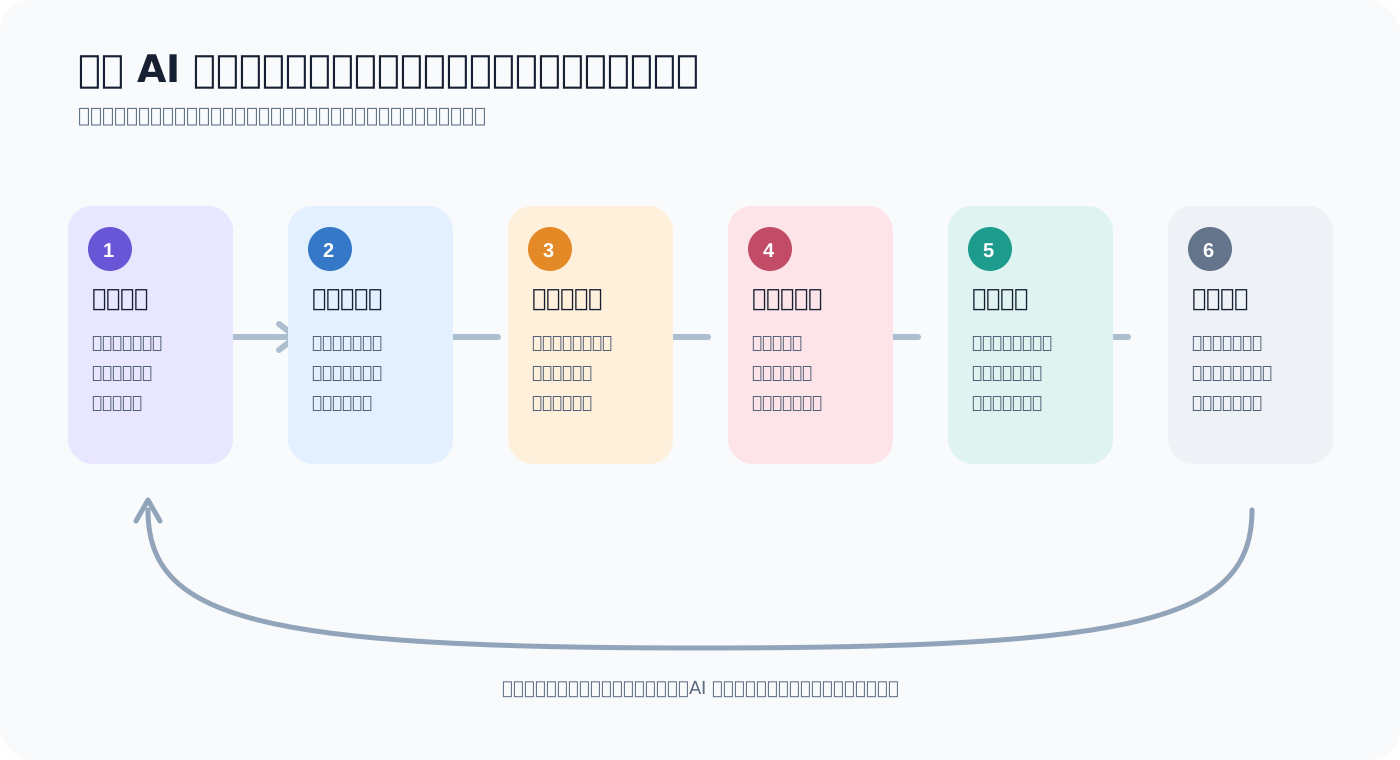
Figure 1: The deliverables of Enterprise AI are not a model response, but a closed loop that can be executed, inspected, taken over and studied.
The model can cover it directly, only part of it. It understands the text, generates candidates, calls tools and sometimes works continuously. Inputs, privileges, acceptances, exceptions, rollbacks and experience depositions will not be completed by themselves as the model is upgraded. Many projects are on the road between the demo and long-term operating systems.
And that explains why some Agent is amazing in the demo, and he's so heavy when he comes into the company. Demo just prove it can't be done. The production environment also needs to indicate under what conditions, what to do when wrong, who to take responsibility for, and how it has proved useful.
System interfaces often grow into team interfaces.
There's also a layer missing.Conway's 1968 article.It offers a simple observation: the organization that designs the system often ends up producing designs similar to its own communication structure. It is not a strict causal law, nor can it be hard to roll out the system with an organizational chart. It merely reminds us that how the team communicates, who has decision-making power and what has to be passed over, will slowly remain in the system's modules and interfaces.
The AI system will magnify this relationship. A production-level system addresses operational objectives, knowledge and data, models and assessments, tools for adaptation, authority, cost and safety.MLOps guide for Google CloudThe continuous integration, delivery and training are placed in the same engineering chain and are handled in a continuous manner. For each vagueer handoff in the organization, there is often an additional layer of interface, approval or waiting in the system.
Take the example of the client's intelligence body. To read customer information, orders, refunds and wind control, the four pieces were originally made by manual approval, and the intelligent usually simply move the serial process into the tool-call chain: Permissions are repeated, the context is lost between different systems and abnormally returned to manual queues. It's not necessarily Prompt at this point, but who's in this flow of values who's in the crossover without a common owner.
Seeing the company AI in Conway's law, it's often seen several typical shapes. The following table shows the design assumptions, not the statistical conclusions of the Stanford sample:
| How does the team work? | What kind of system is it? | Common trouble. |
|---|---|---|
| Data, algorithms, applications, security, each team working in line | Each floor has a platform or service, which is spelled by a cross-team interface | The knowledge base is slowly updated, the power models are inconsistent, and the failure is going to be multiple teams. |
| One AI, center stage, all scenarios. | Large unified Agent or RAG platform, business team scheduled access | The platform becomes a bottleneck, and real business differences can only be resolved by bypassing the platform |
| Business area team to end responsible, with shared platforms next to it | The scenes can evolve on their own, and the platform provides a unified model, retrieval, audit and assessment capability | There is still tension between autonomy and re-use, but the border and the owner are easier to tell. |
Conway's law can't be used too hard. The organization has a customer service, order, wind control and knowledge department, which does not mean that the system should be able to break into customer service, order, order, and control and knowledge. The sector chart is not a multiple Agent diagram. The identification of capabilities by mandate, context and instrumental boundaries should be followed by a judgement as to which of these steps are truly worth independenting. Many Agent is better suited to situations where mandates can be parallel, where context is prone to pollution or where different tools and expertise are indeed needed. In the rest of the scenes, simple, combustible workflows are usually easier to inspect and maintain. The system reflects teamwork among teams, but does not have to translate one-to-one departmental interface into Agent.
Microsoft’s guidance on AI CoE has a similar meaning: AI capabilities are usually built on existing cloud, data and governance teams, rather than creating a separate island that only “dos model”.Microsoft AI CoE Guidance For developers, this means that the system ' s owner, input-output contracts, permission boundaries, SLO, evaluation and upgrading paths are best matched with real teamwork by teams. Once the tool is used, the chain is long and thin, and it is possible to see whether there is also a high frequency, vague, unaccountable interface between the teams. Governance should not be seen only once before it is online.Govern section of NIST AI RMFPosition roles, responsibilities and risk management throughout the process.
Where the project is expensive, it's often not called in.
The Stanford report has two sets of figures that can be easily extracted into headings: in successful projects, 77 per cent of the problems that respondents consider most difficult are “unseeable costs” of change management, data quality and process re-engineering; 61 per cent of successful projects have experienced at least one failure before they are currently successful. Models remain important and enterprises need not consider failure as a mandatory stage. These figures are a reminder that the cost of the model, which is finally written in ROI, often does not include the organizational work that the project consumes. Data problems are not the same as cleaning up all historical records. The team had to decide which data were useful, who could access them, update them and how mistakes could be pursued before the project would remain in place in pursuit of “ideal data”.
Businesses rarely start with ideal data. In many scenarios, LLM itself has become a tool for data processing. Ninety-one per cent of the cases successfully processed unstructured data, and 88 per cent of the cases LLM helped businesses to open data assets that existed but were not available. In the past, data was scattered across multiple systems, belonging to different teams, and no one could really get it together. There is now at least one more way for enterprises to extract, sort and feed these materials into the workflow.
The anonymous logistics cases in the report are a good illustration of this. Invoice processing appears to be typical of AI missions: reading invoices, ticking fields, matching orders, entering systems. However, projects began with the accumulation of duplicate templates over the years, mixed input of telephone mail scanners and exceptions that must be constantly corrected by business experts. The team compressed the chaos template before arranging for the field personnel to review the output of the model, connect the process to the ERP, and continuously remove collaborative resistance from the top to the project. The model is certainly inside, but it's just one of them.
If only RAG, Agent, tool call and model paths are available in the framework chart, these tasks can easily be left out of the chart. They decide, however, whether users will trust the system, whether business will stop old processes, whether the data team will open the interface and whether the legal services will allow for higher-value examples. The project may have a usable prototype, but there is no set of practices accepted by the organization.
It's like the J curve that economics often says. After the general technology has gone into the company, the organization has to invest in a rewrite process, train people, collate knowledge, supplement data interfaces, and establish governance and assessment. The benefits are more likely to emerge when these things are slowly stabilized in the short term when inputs are visible than returns. Businesses should certainly not tolerate the lack of results indefinitely; if the budget covers only models and developments, and considers other inputs as additional frictions, commercial judgements can be distorted from the outset.
The costs of Enterprise AI are not limited to token, GPU, SaaS seats and vendor offers. The system should also try to avoid being tied to a single model and model routed where appropriate. The greater cost is to re-establish a certain task, to connect it, to find out what it is, and to be held accountable for what has happened. It also counts the costs of allowing failure: not only is it a hard loss from a failure, but also whether the team has the opportunity to continue to adjust to the failure.
The project will be stuck outside the staff's reluctance to use it.
When projects move slowly, managers can easily attribute the causes to the following: inert, intransigent, and unmotivated. However, if employees have written materials, checked information and made preliminary analyses in private using generic models, the problem is not always the use of the will itself.
The contradictions in the Microsoft report are real. The staff knew that AI was important, but did not believe that the organization would reward them for short-term uncertainty for AI. A person who spends three days re-engineering the handover process may in the short term be under-reporting of the old format; if performance is only in terms of the number of weekly reports, the most prudent option is not to change.
In Stanford, resistance is also often not derived from end users. The functional units of Legal, HR, Risk, and Compliance were more frequently mentioned by interviewees. This does not amount to conservativeness in these sectors, let alone to circumvent the law. They are inherently risk-taking for the organization. It's not surprising that the team took a blurry Agent at the last minute to ask for permission, and it got vetoed.
More practically, these actors have been involved in the design of work from the outset. Legal and compliance definitions define which data are available, which records are to be kept and which actions must be identified; what mistakes are to be corrected by wind control and which must be blocked in advance; and what new jobs HR and the head of operations would have to answer, when released. First-line users cannot simply be responsible for opening new tools, and they know what really does to ease the pain.
Otherwise there'll be Shadow AI. In order to finish the work, the staff still follow the old process and use personal tools to make up for efficiency. Individuals may benefit, but companies are not equipped to be manageable, auditable and reusable. In many companies, the gap between formal supply, governance and real demand is too wide, and the private use of staff is growing in this gap.
The continued removal of barriers to sectoral synergy at the senior level, the provision of trial and error space, the availability of platforms and infrastructure, and the acutely needed locations for front-line staff will reduce the time frame for the project to be deployed to deliver results. In turn, staff learning new technologies, project iterativeity, data preparation and cleansing, processing compliance requirements and the completion of process files slows down. How fast the project can run depends on how these conditions are superimposed.
The division of labour requires a look at the work itself, and then at the changes it brings.
The project is being re-engineered in a participatory context with the human and the Agent. In the case of teams, managers also decide how to allocate tasks: where to go, when to take over and who to take the results.
We'll split a job and talk to who. Information gathering, information collation, candidate generation, finding anomalies from a large number of records, often with relatively clear input and acceptance patterns, may be more than done by AI. Project positioning, resource trade-offs, client commitment, cross-team coordination, usually involve more background information and judgement, and the person in charge should remain in the hands of the person in charge.
What happens when mistakes are made, and the division of labour is changed. Mistakes are easy to detect and easily amend, allowing AI to finish first; when errors affect clients, funds, compliance or brand names, manual review is to be placed before delivery, the system leaves a path of upgrading and rollback. Some of the work also appears to be process-stable and is based in practice on client history, teamwork and business continuity. It is difficult to clarify such contexts at once, and it cannot be assumed that the model has been understood.
It is equally worth asking whether outputs require unique judgement. The code, the complete version, is suitable for AI to speed up; with the content of corporate strategy, aesthetics and brand orientation, AI can help to spread or draft, and ultimately it will have to be changed from one person to another. This division of labour will allow people time to return to places where judgement, communication and consequences are more difficult to outsource.
A sentence “AI to assist in writing proposals” cannot guide the actual work. The team needs to break down the process into steps, write where it came from, what AI could do, who could review where it was, what had to be upgraded, and who was responsible for the final delivery. Manual modifications to the results are also to be retained: some are changing facts, some are binding on the replenishment and some are from experience. They should not disappear as a single delivery ends.
The contents are written in order to be handed over to AI in a stable manner; the team knows who will take over when the exception appears. The difficulty of the division of labour is to place the handover, review and responsibility in each concrete step.
The number of calls and the minutes saved after the division of labour had been online are only partially indicative. It also depends on whether the quality of delivery has changed: whether the results are more accurate and fit for the actual scene or whether the return to work is left to the next colleague. It depends on where the time saved goes. If the team spends time on user insight, judgement and relationship work, efficiency becomes a business residual; if you just wait to check the AI output, the process may be just one layer more.
Last look at the feeling. Is manual review ever light or is it always a big change? Will the exceptions be successfully handed over to the responsible person or will they return to the vague crowds of conversation and ad hoc coordination? These changes are more problematic than a nice call scale map. Modelling capacity, business conditions and team experience will change and the division of labour will need to be adjusted accordingly.
It's not necessarily the smartest job to get into production first.
When an enterprise does AI, it is easy to prioritize according to whether it appears to be smart or not. Models that can write strategic reports seem to be more valuable than models that sort out the work orders. The order of landing is often the opposite.
Successful projects begin more often with less romantic work: high frequency, duplication, heavy backlog, relatively clear input and the ability to check results. Such features are found in the security diversion, invoice processing, initial screening of passenger service, procurement of replacements, filing of documents, intellectual retrieval, and migration of legacy codes. They may not be simple, but what is accomplished is usually clear and mistakes are more easily contained in the recoverable range.
In Stanford's success sample, the fully autonomous smart body program is only part of it. More projects start with the conventional component, allowing AI to handle high volumes of recoverable work and to keep key outputs and exceptions within manual clearance. This observation is more appropriate to understand the order of landing: entering stable, results detectable, errors that can be remedied and making it easier to get into production first; clinical paperwork, external content, high-risk decision-making and complex codes still require longer collaboration and auditing links.
The degree of automation does not accord priority to this decision. The team can first place AI in a clear, easy-to-verify link to confirm that input, acceptance, abnormal processing and rollback can work steadily, and then consider whether to expand the delegation of authority. For AI application developers, a valuable capability is the process of organizing the work that the operational staff cannot describe into models that can be involved, implemented by the system and manually validated.
Software development and game development didn't escape this pattern.
It's a very specific matter to put it in software development.
The company has been able to read the warehouse, change the files, run the commands, move and retest. A code is generated and does not amount to a demand being delivered. The project also includes requirements boundaries, systems of dependence, testing, CI, code review, distribution windows, monitoring, rollback and online responsibility. When the developers deliver the writing, more effort will be directed towards defining acceptance and inspection, identifying risks, arranging feedback and undertaking final changes. Instead of starting with an automatic end-to-end delivery, put Agent in a clearer step of testing, review and rollback.
AI Coding is particularly suited to modeled changes that complete the certification chain: lot migration, interface replacement, configuration upgrade, test completion, local repair of known bugs. They all have relatively clear diff, test and rollback paths. Demand is not stable, structure is complex and cross-team responsibilities are blurred, and the model is not moving beyond organizational context.
DORA 2025 Similar reminders were given from the software delivery perspective: the effectiveness of AI will be influenced by the feedback capacity, platform capacity and working methods already available to the team. The study was about software organization and could not be pushed to all enterprises; it was still useful for those who were developing tools and engineering Agent. Partial acceleration does not automatically turn into a system that is faster, and the gaps in the original process may be more rapidly magnified.
The same is true of games and content production. Assuming that the team has enabled AI to generate activity configurations or task text, the production chain is not just a script. The configuration requires a Schema check, ID exists, rewards meet the rules, mission pre-conditions cannot conflict, sensitive content is readable, version changes are rolled back, and ultimately the pace of judgement, player experience and branding are planned. The model can be a quick candidate, but the ability to enter the project depends on the team's having the certification and responsibility arranged.
The more the model is generated and action is taken, the more it is validated, authorized, logs, rollbacks and assessments that cannot be completed until they are online. They are an integral part of productivity.
Headcount Reduction and conclusion
The productivity gains were real for the enterprise projects, and management had to decide how to use that component of capacity. In Stanford ' s success sample, the reduction was the largest single result, but not the majority. Projects have also chosen to avoid new recruitment, shift people to higher-value jobs or speed up product routes with the same manpower.
This is, first and foremost, a business choice. Companies can switch the time saved to faster delivery, higher service levels, more detailed customer coverage or lower personnel costs. The system does not make decisions for management. Growth opportunities, budgetary pressures, product backlogs and re-assignments will affect how this path is going.
Speed also brings more than cost advantages. It's like moving speed in a MoBA game: it doesn't make decisions for the player, but it changes the timing of chase, retreat and support. The same is true of efficiency in enterprises. It opens up options that were not in time to do, cannot do or cannot be prioritized, and it remains for management to decide where to use this balance.
Did the time saved translate into business results? What was people turned to for? Is the service for the client getting better? If there is no answer to these questions, the effect would probably be to look more or less beautiful in part. The reduction of staff is only one result that the enterprise may choose and not the only way to achieve efficiency gains. If the company had made the reduction the only goal, the employee would probably have refused AI, and no one wanted to lose their jobs.
Enterprise AI is piloting, often because companies have not yet integrated what models can do into something that can be accepted, taken into account, picked up by problems and then continue to learn.
The product goes from answering questions to doing things for others, across the capacity boundary. The organization still has to work with the development, operations, platforms and governance team to build this capacity into stable values.
References
- Microsoft Work Trend Index,2026-05-05。
- The Enterprise AI Playbook,Elisa Pereira、Alvin Wang Graylin、Erik Brynjolfsson,Stanford Digital Economy Lab,2026-04。
- State of AI-assisted Software Development 2025,DORA。
- How Do Committees Invent?,Melvin E. Conway,1968。
- Google Cloud MLOps Guidance。
- Anthropic: Building Effective Agents。
- NIST AI RMF: Govern。
- Microsoft: Establish an AI center of excellence。
- Title: Why Enterprise AI Gets Stuck in Pilots: Systems, Workflows, and Organizational Absorption
- Author: Hyacehila
- Created at : 2026-07-22 13:00:00
- Link: https://hyacehila.github.io//blog/2026/07/22/enterprise-ai-from-delegation-to-absorption/
- License: This work is licensed under CC BY-NC-SA 4.0.