
When AI Stops Answering and Starts Doing: Anthropic Economic Index Report: Cadences

“Ai has replaced a lot of jobs?” The question will always come back. It seems to have a straight number: how many jobs have disappeared, how many people have been pushed over by models, how many industries are most dangerous.
But the first change is often not in these places. More like a little move in the work, it's changed: whether an email should be written from the beginning, whether a code should be moved to Agent first, whether the reporter is asking the model a question, or whether it should hand over a half-finished piece to it to keep doing it. The number of companies, wages and recruitments will sooner or later be affected, but that is the latter account. The previous accounts first occurred on how the mission was opened, who made it, who accepted it.
Anthropic Issue 6 of the June 2026 Economic Index Report: Cadences, is parked at this earlier site. It doesn't count "AI has replaced a few people," but it looks at when Claude's users appear, take what they produce, and give the model how much execution. Read the full text, I think it gives not a larger conclusion, but a smaller and more specific set of observations: the work begins with talking and asking questions and answers, and turns into products, environments and commissioning.
And it determines how to read it: to see where change comes from, and to see where it ends.
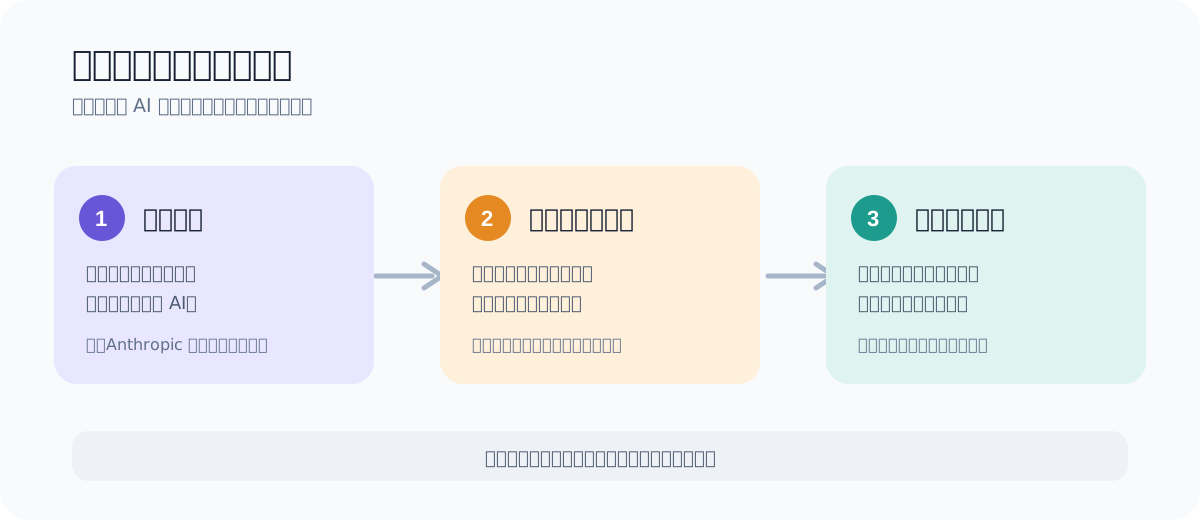
Figure 1: Evidence of AI and work cannot be read intermingled. Data sources and scope of research are presented at the end.
Before we start.
At least three layers of data are available between AI and the job.
The first thing I've ever seen is...Use behaviourI'm sorry. Who opens the model with chat frames, desktop tools or API, to explain, write documents, write codes, or do a series of things. Anthropic reports are mostly down this level. It tells us whether the tools are actually going into everyday work, and it shows whether some way of using is starting to become common.
I'll be back.Task EffectsI'm sorry. Does the same type of job differ in speed, quality, error rate when there is an AI and there is no AI? Such questions cannot be answered by a journal alone. Researchers have to find similar people, similar tasks, and try to strip out differences like “the better people who are already doing more” like “AI”.
It's the last time.Labour market outcomes• Any changes in wages, hours worked, recruitment, number of jobs and occupational mobility. It's going slowest. Today someone who has written a report with Claude will not be immediately in employment statistics; will the company be less hiring, changing its position, leaving its revenues to shareholders or employees, and subject to changes in budget, management and demand?
So, in the phrase “AI is strong, work is out”, there are three different things that are often embedded: immediate use experience, local efficiency improvements and fears for the future. Combination of them, the discussion will soon lose its focus. Anthropic reports are on the first floor, reaching out to the second two. We can follow it, but don't cross it.
Looking at the samples, there are many unnecessary misunderstandings. This report uses data from Claude, a continuous sample and treated with privacy protection, and thus allows for a daily and hourly tracking of the rhythm. Chapter 2 Chat and Cowork data cover the period from 10 April to 10 June 2026; Claude Code was included in the comparison of the level of commissioning. Occupational wages are derived from the May 2025 statistics of the United States Bureau of Labor Statistics. (Anthropic, 2026, pp. 9-18)
Anthropic does not allow researchers to read chat records article by article, but uses a sorter to mark the session as a job, personal, course use, or to identify the product that the user lasts to take away, filtering cells that are too few. It can draw the overall contours, but it does not give the whole context. The sorter would also be wrong and it would be more appropriate to treat these figures as a map with limited resolution. As for the survey component, Anthropic will answer the question in relation to the use of the mode of privacy protection, with each user randomly taking up to 20 samples of the sessions, and eventually receiving about 9,700 respondents, with at least five sessions. Computer and mathematics professions account for about 30 per cent of them, but only about 4 per cent of the United States workforce; there is also a clear bias in the management. (Anthropic, 2026, pp. 19-21)
This is an active image of Claude users, not a microcosm of American workers, and it is not possible to move directly to explain Chinese employment. The borders are clear, and the observations in it are worth looking at.
And where did it change compared to the last issue of "Learning Curves"?
The last issue of Anthropic was published on March 24, 2026.Learning CurvesI'm sorry. The issue, which drew data from February 5-12, 2026, focused on two questions: whether Claude's use was expanded from a few technical tasks to more uses; and whether people who had spent more time were more likely to use AI.
It gets a very similar picture to the title of the learning curve itself. The top 10 categories of Claude.ai have dropped from 24% in November 2025 to 19%, which is used in dissipation; and Claude is more often used by people who have used him for tasks that require more work and education, and has a higher success rate. Early adopters may be more skilled, and those who remain today may be better suited to use Claude, so in this case, “long-term” is a combination of learning, screening and survivors. # I'm not sure #Learning Curves,pp. 2-4, 15-20)
The Cadences did not reverse these conclusions, but brought the problem a little closer. The last issue looked at adoption and learning: which tasks were spreading and which users preferred models and were more willing to overlap. This period began to look at how jobs were being reorganized: at what time people used AI, leaving with explanations, reports or codes, and leaving much judgement to models.
| Contrast Dimensions | March Learning Curves | June, Cadences |
|---|---|---|
| Main issues | Proliferation of use; improved use of experience | AI, how to get into the routine; what products the user takes; how deep is the commission? |
| Data Form | Compare mission, platform, model selection and user time in a sample of one week per February | Continuous sampling, allowing day/hour changes; addition to product classification, cross-product comparison and correlation surveys |
| Key findings | Claude.ai dissipation; older users are more iterative, more useful and more successful | From chat to Agent, the product environment allows for closer assignments to be more deeply commissioned; users start using model outputs as work products |
| Still can't answer. | Whether these learning differences are caused by the use itself | Have these commissioning changes been translated into changes in wages, working hours or employment |
Both issues are not automated, and AI is the primary concern of every user. The March issue splits the interactions into two categories: direct, feedback loop, task itseration, validation, learning, and integration into categories such as "information " and "assistance " , and looking at how people fit in with models. It concluded that older users were more traverse and learning and did not simply throw a brain at a model. Of these, automation appears in the Agent mode of API call, and it is more like human collaboration in tools like Claude Code.
The new autony in June is another ruler: how much does the model have to decide on its own in a mission, in terms of the depth of the commission. Claude Code is more autonomous and does not fight “old users more” . A person can fully retain feedback and acceptance on high-risk or complex tasks, while at the same time handing over a clear section of the border to Agent. Two issues are taken together, and the conclusions are naturally not conflicting.
Anthropic did not announce that AI was replacing someone. It just pushed the camera from "Who Learns to Use AI" to "Who is Giving Ai the part of the job?" The re-ordering of labour has also changed from a macro-judgement to a few things that can be observed: the time used, the product taken, the depth of the commission, and the feedback chain left in hand.
Claude's use of rhythms is already like work and life itself.
Chapter I of the report reads as a daily hotshot: morning news, morning business communications, evenings to find recipes, and suddenly, before the tax deadline, a lot of tax issues were being crowded into. These requests look trivial, but they just mean that AI has gone along with people, and it's part of life, and it's not just a chat box that's opened up on occasion.
During working days, about 35% of the sessions in Claude Chat and Cowork were awarded personal use; by weekends, this percentage had risen to almost 50%. Business communication, marketing paperwork and slides are less demanding, and emotional support, medical problems, and investment advice are becoming more numerous. In the morning, news requests are concentrated, business communications fall high on the morning of work, and the menu requests reach approximately 2.3 times the usual time at 6 p.m. (Anthropic, 2026, pp. 4-7)
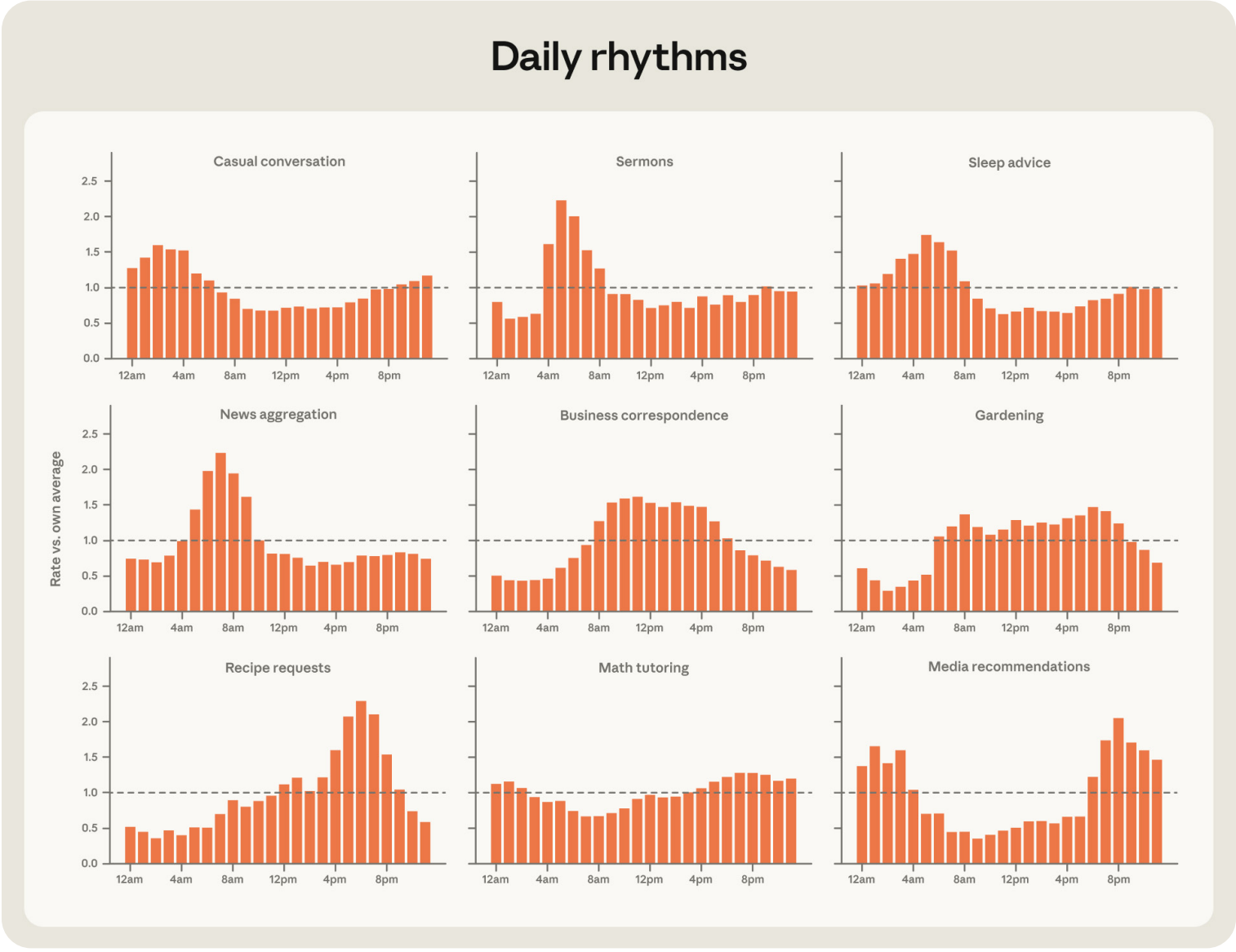
Figure 2: Anthropic original Figure 1.2. The columns indicate the relative frequency of the request cluster during that hour, with a dotted line representing the average of the request cluster itself; the data are limited to Claude Chat and Cowork. Source: Anthropic Economic Index Report: Cadences (2026), p. 6.
The tax part is particularly intuitive. The United States had a federal income tax cut-off date on April 15; on April 14, users had about eight times the average tax-related conversation of May, and April 15 remained high, with April 16 coming back fast. This cannot be used to calculate how much AI has done for tax officials. It just takes a very common picture: once there's a concentrated, clear, online pressure in real life, people will look at AI as a ready entry.
There is also a pattern of night and weekend work requests: they tend to favour tasks corresponding to high-wage occupations; and the proportion of jobs related to low-wage fours has declined. AI ' s use follows the level of professional remuneration, as has been seen in the Learning Curves; this period cuts data to the hourly particle scale and shows a new rhythm.
It only reminds us one thing: AI will not evenly penetrate all jobs. It will grow with the established time frame, digital environment and mission boundaries.
From "Assent well" to "What delivered."
The most important change I care about in this report is that it starts to record what was taken when the user left the session.
Anthropic called the main output of a conversation artifactAnd it can be understood as a work product that can be taken away. It may be an explanation, a report, an e-mail, a presentation, a code, or a website. The term is not very daily, but it is closer to the work site than a model response.
The report identified 93% of Chat and Cowork sessions that produced some sort of explicit product. The most common are explanations, 17 per cent; documents and reports, 15 per cent; and recommendations and guidance, 11 per cent. This does not mean that the model's written content is being used, but the question has been moved forward: what does the user do with the model's output?
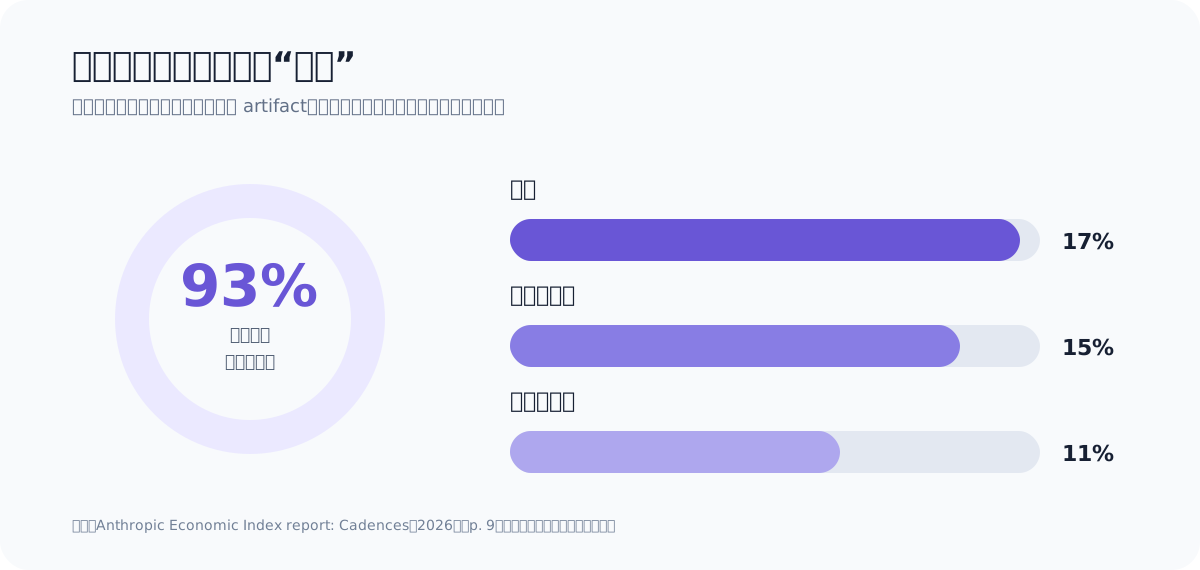
Figure 3: High frequency product categories reported as disclosed; “generation of identifiable products” is not a hierarchy with the three types of specific products and is not added.
The same product can be used for completely different purposes. One plan may be a travel strategy or a financing programme; translation may be either for personal reading or for daily work. Once the report is cut again according to work, personal and course uses, the difference emerges: the work uses are most frequently documented and reported, followed by explanations, draft mail, analysis and summary; and the personal uses are more frequently explained and recommended. (Anthropic, 2026, pp. 10-12)
In the past, the chat models were discussed, and people often looked at the answers as good enough and as little as they imagined. These problems are not obsolete, but are a step in the stream: the output of the model is being forwarded, pasted, run, modified and submitted, sometimes directly into a semi-finished product delivery.
The report also looks at token consumption together with professional wages. Overall, more tokens are used for work sessions that map high-wage occupations, and high-calculation products are more frequently found in these occupations. This correlation is worth reading, but don't read it as "token equals economic value." Career mapping itself is wrong, model selection affects token and occupations such as pharmacists are clearly retrogressive. More conservatively, models and people tend to invest more when users let AI handle more complex, open products that require constant judgement.
The same thing. The same thing.
And the second half of this chapter, aautony, asks another thing: how much judgement did the user give to the model?
Anthropic uses a scale of 1 to 5 to assess AI autonomy in a session. Translation, computation, question and answer are often low, as people almost clarify the answers and boundaries. Applications, websites, games and presentations are higher and models are selected in many options. This score is not related to whether the model has tool privileges or no consciousness, but only describes one thing: how many choices the model makes in this task.
The most interesting comparison occurred between Chat/Cowork and Claude Code. Claude Code has a higher average autonomy in almost all product types; the average difference for the plenary session is 0.37. Claude Code is 0.26 points higher even if only Sonet is used. This set of figures draws attention back from “which model is stronger” to the product itself: how people use the model depends on what capacity the interface gives and on what task is put into the workflow.
Blogs and articles are a good example of how to understand. Chat and Cowork have a median session that eventually produces a blog or article, which is rounded up by 13 rounds; Claude Code has only one human hint for the same product. About two thirds of the autonomy gap is not because Claude Code users are doing another batch of tasks, but because the close tasks are being given to the model in different ways. (Anthropic, 2026, p. 15)
The chat interface allows people to re-establish, read and continue to adapt; and the Agent environment, which reads documents, calls tools, works continuously, makes it easier to have sex with the target, the boundary and the acceptance conditions. When discussing AI substitution, it is common to focus only on modelling capabilities, and changes in this layer of product and work stream are less visible.
This is also a follow-up to two articles I wrote earlier. I'm not sure.The generation, AI, will not just close the job, but re-schedule the work, then expand the demand.The judgement is that AI was first compressed by a mission, not by a full career; now the report gives a picture of the mission level, where the work is broken down and the product is placed in different levels of trust. I'm not sure.AI Agent's future is not a full autonomy, but a manageable commission.It is not about whether or not people should quit, but about who should remain in the target, the boundary, the acceptance and the responsibility. The new data do not support these two sets of judgements, but make them less abstract.
Users feel they're being helped or replaced.
Chapter III begins with a question, not just a journal.
Nearly 60 percent of the respondents felt that AI would be able to perform more tasks independently in the next 12 months than it is today; more than one third of the respondents expected that AI would be able to do most or almost all of its tasks by then. The figures appear to be strong, but they measure the expectations of the interviewees, not an independent assessment of their positions.
Nor is there a correlation between the way in which it is used and the way it is felt. The more highly automated users tend to believe that AI will have a more positive impact on future income, re-employment, job significance and autonomy; they also more often say AI has increased the market value of their skills. It also mentions that many users report that they have improved speed, scope and quality. (Anthropic, 2026, pp. 27-28)
It's easy to be told as a story: the more you give your job to the AI, the less you're afraid of AI. It may be that automation has indeed brought benefits to these people, or that it has been more optimistic and willing to try new tools, which has made them more willing to hand over their full tasks. Even if you control the user's time using Claude, the selection effects are not cleared.
The other side didn't disappear. About 10 per cent of respondents felt that they were at a high or high risk of losing their jobs in the coming year; there were also concerns about junior colleagues and others, not themselves. This is like the mindset that is common in technological change: tools are helping me, but I can see who it will squeeze first, especially those with less experience and easier to break down into clear steps.
There is no clean answer. It is not surprising that AI brings efficiency, anxiety, learning opportunities and job concerns. Each person faces different tasks, different backgrounds and different possibilities for examining model outputs.
This report doesn't prove anything.
The first thing to write is that it doesn't prove how much AI has created employment substitution.
The report does not observe the number of companies, payroll and recruitment decisions, nor does it randomly divide users into “Approve AI” and “No-Approve AI”. It sees Claude user behavior, task attributes derived from the sorter, and self-reporting by a group of users. We can tell from it what missions AI is entering, but we can't say that a job will disappear in a few years.
Automation is not a cause or a consequence of optimism. People with a higher percentage of automation may be in posts that are more suitable for AI, better tools, or more willing to believe in technology. The report has been valuable in bringing out this relevance, but it cannot answer “is it more likely that a person will feel safer by commissioning more”.
Token is not the value of the output, nor is it the result used. The model, in order to produce a more computing application, does not indicate that the programme is better, let alone that it creates the same percentage of value for the company. The ability of users to validate, organizational adoption and real processes of mission entry will slowly determine the economic impact.
Claude's data is not naturally representative globally. It is well suited to observe those who have come into contact with and have taken the initiative to use the front model. The product entry, enterprise software environment, industry structure, labour system and payment patterns vary in China. It was reasonable to use the report as a window of international knowledge; it was too soon to translate it directly into a forecast of employment in China.
Put it back in the bigger evidence. It'll be a little more stable.
Looking at Claude's log alone, it's easy to push it; and looking at several external studies, judgment is less.
NBER's "The One"Generative AI at WorkIt looks at a very specific scenario: the average number of problems solved by 5,179 passenger service providers with access to AI-generated assistants increased by 14 per cent per hour; the number of new and low-skilled staff increased by about 34 per cent, and the change in senior and highly skilled staff was minimal. This does not mean that all white collar missions will have the same effect. It illustrates that where mission standards are clearer and feedback is fast, tools can spread a portion of the practice of high performers to less experienced people.
Another NBER studyStill Waters, Rapid Currents: Early Labor Market Transformation under Generative AIThe Danish Labour Market is the subject of a review of the Danish labour market. ChatGPT has not changed significantly in its income and time-time recording, and research design can exclude impacts of more than 2%; but the work structure is moving, new tasks such as content generation, AI supervision, AI integration are emerging, and the users are moving to more relevant and better-paid occupations for chat robots. (NBER Working Paper 33777)
The title “Silent surface, stormy water” is very appropriate. It's not in conflict with Anthropic's report. The former says that macro-labour indicators are not visible for the time being, while the latter shows us that tasks and work streams under the band are being rearranged.
International Labour OrganizationGenerative AI and Jobs: A Refined Global Index of Occupational ExposureThis gives a broader context: about a quarter of the world's workers are in “specified AI exposure” occupations, with only 3.3 per cent of global employment falling into the highest exposed categories; according to ILO, most jobs are still made up of jobs that require human input, and therefore jobs are more likely to be transformed than jobs are eliminated as a whole. (ILO, 2025)
Exposure is equally not equivalent to unemployment risk. It only says how many jobs in a profession might be met by a generation AI. Whether it is adopted, who ultimately has the efficiency gains, how the organization has been re-diversified, and whether there are new demands, still needs to be answered by subsequent data.
The change has begun, but it hasn't grown into a slogan yet.
If I sum up this report in one sentence, I would say that the early impact of AI on work begins with people giving more execution, not with a sudden loss of the whole career.
This sentence is not as exciting as "AI will replace human beings," but it is closer to what can be seen now. The answers in the chat interface are becoming documents, codes, programs and successive tasks; the relationship between people and models, from your one-word collaboration, slowly becomes target setting, environmental access, implementation, inspection and taking over.
It'll reorder a lot. New persons who have accumulated experience through repeated implementation may be more easily taken over by Agent; the ability of senior workers to judge, accept and accept and define boundaries becomes more visible; and organizations have to re-decide which tasks need to be performed by hand, which can be handed over but must be left behind. But these are not yet judgements on the total number of jobs.
The next thing that is worth pursuing is a few more specific things: whether the task entrusted to you is stable, from drafts and one-off analyses to processes that affect the real state; who is responsible for model outputs, and companies are not investing new jobs and time in review, acceptance, redress and authority management; whether primary workers were replaced by training opportunities that they had obtained through repeated implementation or changed to new learning paths; and whether efficiency gains ultimately flow to employees, companies or consumers.
Anthropic, this report does not answer these questions for us. It did a basic but necessary thing: to tear back the vague term of work and the actions that people are doing every day.
The first two questions determine whether efficiency is going into the organization, the third is how the next generation grows judgment and the last is who gets the proceeds. The data are still waiting longer.
References
- Anthropic, Anthropic Economic Index report: Cadences, 2026-06-26。
- Anthropic, Anthropic Economic Index report: Learning Curves, 2026-03-24。
- Erik Brynjolfsson, Danielle Li, Lindsey R. Raymond, Generative AI at Work, NBER Working Paper 31161。
- Anders Humlum, Emilie Vestergaard, Still Waters, Rapid Currents: Early Labor Market Transformation under Generative AI, NBER Working Paper 33777。
- Pawel Gmyrek et al., Generative AI and Jobs: A Refined Global Index of Occupational Exposure, International Labour Organization, 2025。
- Title: When AI Stops Answering and Starts Doing: Anthropic Economic Index Report: Cadences
- Author: Hyacehila
- Created at : 2026-07-18 12:00:00
- Link: https://hyacehila.github.io//blog/2026/07/18/anthropic-economic-index-cadences/
- License: This work is licensed under CC BY-NC-SA 4.0.