
Backend Data Boundaries: How a Question Reaches a Q&A Bot

In the previous post, we gave a Q&A bot that could only be called inside a Python process a network entry point: POST /chat. A client sends question, the backend passes it to a language model, and then returns answer. Whether the client uses curl or fetch in a browser, it can reach this endpoint by following the same HTTP agreement.
Receiving a request, though, does not mean we can safely use it. What if question is missing or contains an array? If I return the entire object from the model call, can the client reliably find the answer? I want to follow these two questions to see how a backend draws boundaries around its data. We are still using the simplest bot: a user asks a question, and the model answers.
Incoming JSON Is Not Yet the Python Object We Want
Without Pydantic, taking a dict seems to work:
1 |
|
A valid request works. But data["question"] assumes the key exists. Even when it does, nothing here guarantees that its value is the string we intend to pass to run_bot(question: str). The str annotation on a Python function parameter does not, by itself, reject run_bot([1, 2, 3]) at runtime. If the model SDK fails later, we see an exception in the middle of the business operation when the original problem was the client’s input. We could write try blocks at every entry point to catch all sorts of errors, but that quickly becomes tedious.
At the entry point, I want answers to more precise questions: which fields are required, what type does each field hold, can a string be empty, and what happens to unknown fields? Together, these rules form the endpoint’s input contract, often called a schema or data contract. They specify what kind of data this endpoint is willing to accept.
Put the Contract into Code with Pydantic
FastAPI commonly uses a Pydantic model to describe a request body. Here is the same endpoint with one:
1 | from typing import Annotated |
ChatRequest describes the HTTP request body, not the request object used by the model provider. When FastAPI sees request: ChatRequest, it reads the JSON body and gives it to Pydantic for parsing and validation. If validation succeeds, the route receives a ChatRequest instance and can use request.question. If it fails, the route does not run; the client receives a 422 response pointing to the error.
Here, question must be present and contain a string from 1 to 4000 characters long. extra="forbid" also rejects unknown fields. Pydantic ignores extra fields by default; it does not reject them automatically. The Pydantic configuration reference describes the ignore, forbid, and allow options.
The type annotation is now more than an editor hint. BaseModel uses it to process incoming data at runtime, and FastAPI places that step before the route function. Whether the client uses curl or fetch, validation does not know or care which language the client was written in.
Required, Nullable, and Default Values
When writing a schema, it is easy to mix up “may be omitted” and “may be null.” Consider these fields:
1 | from pydantic import BaseModel, Field |
question is required and cannot be null. context is also required, but its value may be a string or null. note may be omitted entirely, in which case it becomes None. limit becomes 3 if omitted and must be between 1 and 10 when supplied. str | None says that None is an allowed value; the presence or absence of a default determines whether the field may be omitted.
Another detail is easy to miss: by default, Pydantic sometimes converts input. A numeric field, for example, may accept a number written as a string and parse it. If that is not what we want, we can enable strict mode for a field or model. We can design conversion rules ourselves here, and leave the details of implementing them to AI.
More complicated requests do not require a giant dict. If the bot later accepts conversation messages, ChatRequest could contain a list[Message], with a separate Message model defining each message’s role and content. Validation follows the nested structure and can point to the particular message and field that failed. Schemas can be composed as the data grows instead of checking only the outermost layer; that is the value of Pydantic’s data contract.
Business Decisions Begin After Input Validation
Suppose the JSON is valid and question is a nonempty string. Can the backend immediately call the model? Not so fast. We at least want to know who is calling the endpoint. A minimal approach is to give the caller an API key and ask it to send X-API-Key: ... in a request header. The backend keeps the expected key, reads the header, and compares the two. If the header is missing or wrong, it stops before calling the model. That is authentication; Pydantic’s check of question is data validation. The two checks answer different questions.
Here is a complete main.py that adds this check to the bot from the previous post:
1 | import os |
First, consider key_from_header = APIKeyHeader(name="X-API-Key", auto_error=False). APIKeyHeader is a class provided by FastAPI in fastapi.security. Calling its constructor gives us an object that knows how to extract an API key from a request header; we store that object in key_from_header. name="X-API-Key" specifies the header name the client must use. There is no HTTP request when this object is created, and no key is checked on this line. It does not issue keys or know the value of CHAT_API_KEY. Its job is to read the header for each incoming request and describe this authentication scheme in OpenAPI.
auto_error=False controls what happens when that header is missing. Here it makes APIKeyHeader return None, leaving the decision to require_api_key(). With the default True, the FastAPI tool would produce an authentication error immediately for a missing header, before our function could handle missing and incorrect keys in one place.
Now consider Depends. It is a dependency declaration imported from FastAPI, not a Python keyword. Depends(key_from_header) does not immediately read a request header. It tells FastAPI to call key_from_header when a request arrives and pass its result where needed. Although key_from_header is an object rather than a function we wrote with def, it is callable and can therefore be passed to Depends(...). We pass the object itself, not Depends(key_from_header()), which would try to call it immediately. The important distinction is that we declare the work now and FastAPI performs it for each request. The FastAPI dependency guide explains the same rule for passing functions.
Read key: Annotated[str | None, Depends(key_from_header)] from left to right. The parameter key will be a string, or None if the header is absent. Annotated[..., Depends(...)] tells FastAPI where the value comes from, and the framework passes the extracted header value into this parameter.
There is one more layer: dependencies=[Depends(require_api_key)] in the route decorator asks FastAPI to run require_api_key() before chat(). We put it in the decorator’s list because this function only checks the key and returns None; chat() does not need its return value. The data flow is request header → APIKeyHeader extracts the key → FastAPI passes it to require_api_key() → chat() runs only if the check succeeds. The inner Depends(key_from_header) supplies a function argument; the outer Depends(require_api_key) requires a check before the route runs.
There are two different keys here. CHAT_API_KEY lets our backend check its caller. The OPENAI_API_KEY read by OpenAI() lets the backend call the model service. The client of /chat sends the first one in the X-API-Key header; the second stays on the machine running the backend. secrets.compare_digest() compares the supplied key with the expected value held by the backend. If authentication fails, raise HTTPException(...) makes FastAPI return 401, and run_bot() is not called. If question fails the ChatRequest contract, FastAPI returns 422. This version has only one key for clients: it tells us someone holds that key, but not which individual user they are.
The client’s HTTP message maps to the code like this:
1 | POST /chat |
X-API-Key is in a request header; question is in the body.
The other status codes are easier to understand by asking how far the request got:
| Situation | Response | Decided by |
|---|---|---|
| API key missing or incorrect | 401: caller not authenticated | require_api_key() raises HTTPException |
| Valid key, but no permission to access a conversation | 403: identity known, access denied | Future business code checking ownership |
| A well-formed conversation ID names no existing conversation | 404: resource not found | Future business code looking it up |
| The type or length violates the contract | 422: request validation failed | FastAPI and Pydantic |
| Too many calls under the endpoint’s rate limit | 429: too many requests | Future rate-limiting logic |
| All checks pass and the model answers | 200: normal result | FastAPI’s default success response |
Our current /chat has no conversation ID or user permission database, so the example only needs the 401 and 422 paths. If we later add /sessions/{session_id}/chat, we can look up the conversation after identifying the caller: raise HTTPException(status_code=404, detail="Session not found") if it does not exist, or raise HTTPException(status_code=403, detail="Forbidden") if it exists but the caller lacks access. Pydantic can check the declared type of session_id; it cannot look up who owns that conversation.
Finally, consider where the different values are placed. Suppose we extend the endpoint to /sessions/42/chat?max_output_tokens=256: 42 is in the path, max_output_tokens=256 is in the query string, {"question": "Hello"} is in the JSON body, and the API key remains in a header. FastAPI reads each location according to the route and function parameters. The client must put values where the API expects them: question=Hello in the query string does not automatically become ChatRequest.question in the body. Next, let us connect these locations to one function.
The Answer Needs a Shape Too
The entry point has a contract; the exit should have one as well. Otherwise, an endpoint that returns {"answer": "..."} today might accidentally return the raw SDK response, an internal request record, or a field that should stay private tomorrow. We can define a separate response model:
1 | class ChatResponse(BaseModel): |
This adds response_model to the route from the previous section, so dependencies=[Depends(require_api_key)] remains in place. run_bot() is still the function from the previous post that calls a real model. The route gives it the validated question and wraps the answer in ChatResponse. FastAPI uses response_model to process the outgoing data and to describe the response in the API specification. The FastAPI response model guide also shows how the declared model filters fields from returned data.
I prefer separate ChatRequest and ChatResponse classes even though they are tiny here. They represent promises in opposite directions. Input contains the user’s question; output should contain only the public answer. Once a database is involved, internal data may also include primary keys, costs, logs, or secrets. A data contract helps us decide how that data should be interpreted and returned.
A Pydantic model is useful inside Python, but it is neither JSON nor a Python dict itself. ChatResponse(answer="Hello").model_dump() gives a Python dict; model_dump_json() gives a JSON string. When we return a regular model from a FastAPI route, FastAPI handles the subsequent HTTP response serialization, so we normally do not call model_dump_json() first. Understanding how these object forms differ and change is one of the important ideas in object-oriented programming.
A Complete Session Endpoint
Here, a session is a Q&A conversation resource with an ID and a caller who may access it. For now, a dictionary in memory stands in for a future session table so that path, query, body, authentication, and response model can work together in one example:
1 | import os |
This still calls the real model. The backend process needs the OPENAI_API_KEY from the previous post and the CHAT_API_KEY it uses to check callers. session_owners exists only to make ownership visible in the example: session 42 belongs to demo-client, while 43 belongs to another caller.
Now read one request from the outside in:
1 | POST /sessions/42/chat?max_output_tokens=256 |
{session_id} has the same name as the session_id: int function parameter, so FastAPI takes 42 from the path and converts it to an integer. Query(...) declares max_output_tokens in the query string; it defaults to 256 and accepts values from 16 to 1024. request: ChatRequest turns the JSON body into a validated object. Depends(identify_client) reads and checks the key from the header, then passes the returned demo-client to the route as client_id. The different parts of the HTTP request now line up with one set of Python parameters.
Only then does the business decision happen. An unknown session_id gets 404; a known session whose owner_id differs from client_id gets 403. The model is called only after both checks pass. With the key above, session 42 produces a 200 response containing session_id and the model’s answer; 43 produces 403, and 999 produces 404. An incorrect key fails with 401 before the route runs, while an invalid question or query parameter gets 422.
The decorator’s responses={...} has a different job: it describes the possible 401, 403, and 404 outcomes for OpenAPI. It does not authenticate anyone or look up a session. The actual responses come from identify_client() and the route’s raise HTTPException(...) branches. That is the distinction between telling callers what an API may return and writing the code that decides what happens to an actual request.
I kept the example in one file so we can follow a request from beginning to end. As a project grows, ChatRequest and ChatResponse can move into a schema module, identify_client() into an authentication module, session lookup into a data access layer, and the model call into a service layer. The route then connects those parts. Splitting code into files does not change what the API accepts and returns or the business rules themselves.
Before and After the Question Mark: Path and Query
The ? in a URL separates two parts. Before it, /sessions/42/chat is the path: it locates the endpoint for chatting in session 42. After it, max_output_tokens=256 is a query parameter, a name=value option for this call. Compare /sessions/42/chat?max_output_tokens=256 with /sessions/42/chat?max_output_tokens=512: the session is still 42, but the output limit changes. With /sessions/43/chat?max_output_tokens=256, we are talking to a different session. If a URL has several query parameters, the first follows ? and the others are joined with &.
This is a useful API design convention: the path usually says which resource we want, while the query says how to access it this time, such as filtering, sorting, pagination, or the output limit here. Both live in the URL, but FastAPI does not merge them into one value. In the code above, {session_id} maps to session_id: int, while Query(...) reads max_output_tokens. That query parameter may be omitted because we gave it a default of 256; query parameters are not automatically optional. Remove 42 from the path and this session route no longer matches.
OpenAPI Is a Readable Map of the API
We have now written the input and output shapes in Python. How can a browser frontend, another service, or a new teammate know what /sessions/{session_id}/chat accepts and returns? FastAPI generates JSON Schema from these models, then includes those schemas alongside paths, HTTP methods, parameters, authentication, and responses in an OpenAPI description.
JSON Schema describes the shape of JSON data. OpenAPI describes an API: its endpoints, how to call them, and what to expect back. JSON Schema can be part of an OpenAPI description. With FastAPI’s default configuration, /openapi.json exposes the machine-readable description, while /docs presents interactive documentation. Writing declarations in a standard form lets a tool generate a handoff document that another developer can use to understand the project.
The screenshot below shows the actual /docs page after starting the complete example and expanding POST /sessions/{session_id}/chat. We did not hand-build this frontend page; FastAPI generated its Swagger UI from the endpoint declarations:
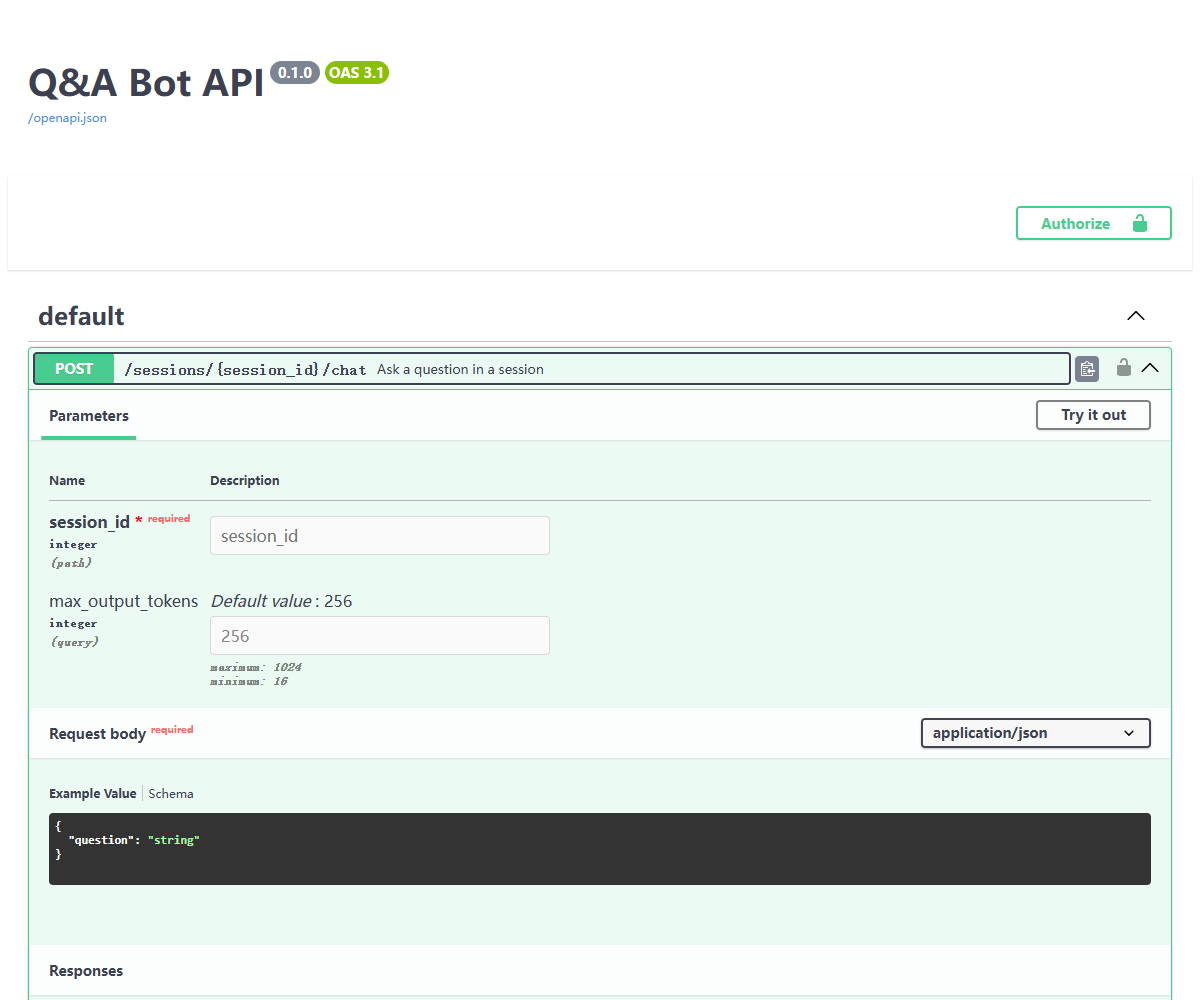
Four parts are worth finding: session_id is labeled path, max_output_tokens is labeled query, question appears in the Request body JSON example, and Authorize at the top is where a caller can enter X-API-Key. Try it out lets us fill in the fields and send a real request. Farther down, the page also lists responses such as 200, 401, 403, 404, and 422. Our responses={...} supplied the descriptions of the three authentication and resource errors; FastAPI added 422 for request validation. The page reads /openapi.json and ultimately calls the same backend endpoint.
The same ChatRequest.question thus takes part in two flows. At runtime, a client sends JSON, FastAPI and Pydantic validate it, the route calls the bot, and the response model shapes the output. At description time, the Pydantic model supplies a data shape, FastAPI assembles the OpenAPI description, and documentation or client tools use it to learn how to call the endpoint. Both flows come from the same declarations, so a field change can update the behavior and its description together.
There is a resemblance to writing a parameter schema for an agent tool: the caller needs to know the tool’s name and argument shape, and the receiver must check the actual arguments. The analogy is useful up to that point. A tool call and a public HTTP API run in different settings; a schema does not take over authentication, authorization, or business decisions in either one.
Back to the Original Question
The session endpoint that grew out of POST /chat is now more than “read JSON and call a function.” The external request first passes the key check, then its values in different locations become Python parameters. The code looks up the session and checks ownership before sending question to the model. Finally, ChatResponse decides what we say to the outside world. OpenAPI makes that agreement available for clients and developers to read and reuse.
This structure takes more code than a bare dict, but it surfaces mistakes earlier and gives both sides of the API a clearer agreement. If we later separate routes, business logic, and data access, we already know where the outermost boundary lies.
- Title: Backend Data Boundaries: How a Question Reaches a Q&A Bot
- Author: Hyacehila
- Created at : 2026-09-30 04:30:00
- Link: https://hyacehila.github.io//blog/2026/09/30/pydantic-schema-openapi-backend-data-contracts/
- License: This work is licensed under CC BY-NC-SA 4.0.